
Implementing the comprehensive NIST Cybersecurity Framework (Identify, Protect, Detect, Respond, Recover) is complex. Organizations struggle to map their diverse IT assets and controls to these rigorous standards.
ManageEngine simplifies NIST compliance by providing integrated tools for asset management, risk assessment, and continuous monitoring. Automate the collection of evidence and streamline your path to a robust cybersecurity posture.
Contact Us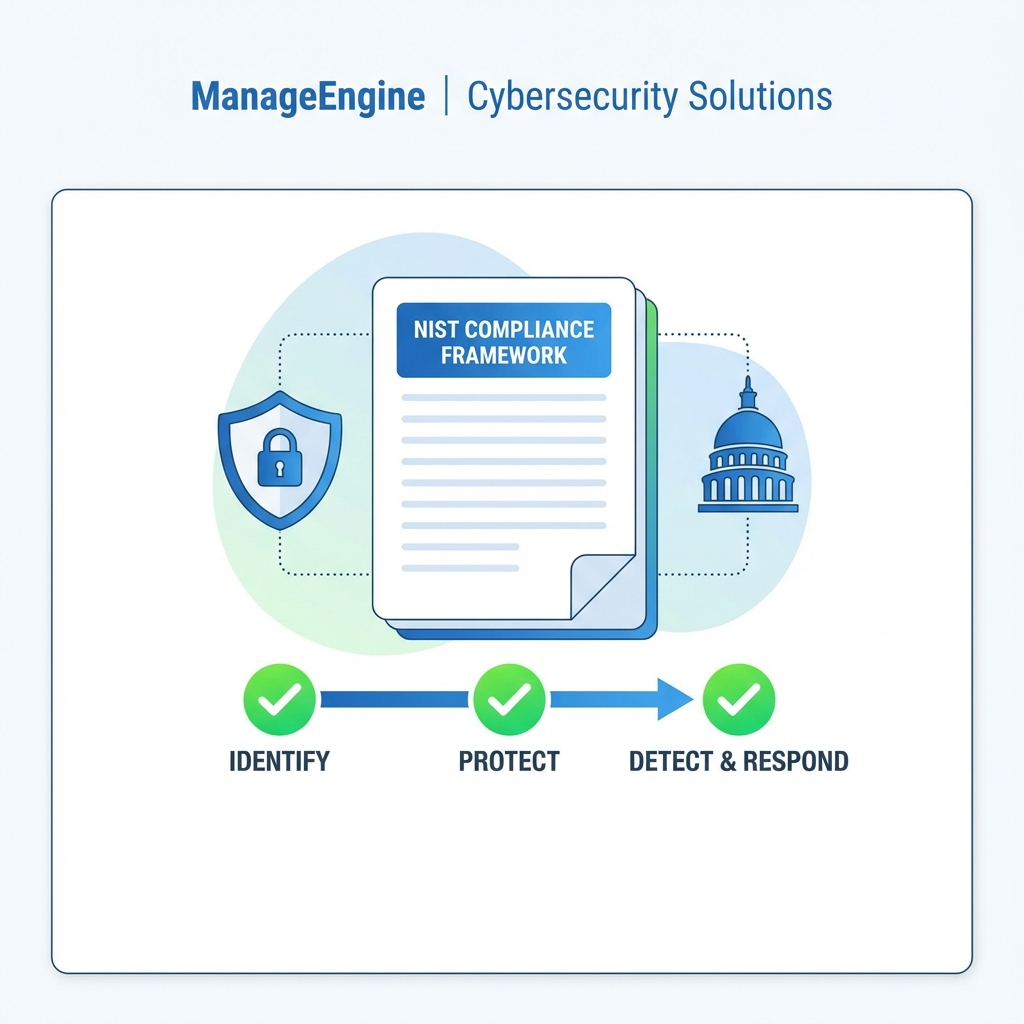
Tools aligned with Identify, Protect, Detect, Respond, and Recover pillars.
Identify vulnerabilities and prioritize remediation based on risk impact.
Generate pre-built reports to demonstrate compliance to auditors.
Align your cybersecurity mission with business objectives and manage third-party risks. Solutions like Log360 provide audit-ready templates and instant alerts for supply chain anomalies, empowering robust administrative oversight and structured policy enforcement.
Discover and manage hardware, software, and sensitive data across your entire hybrid environment. Utilizing AssetExplorer and Endpoint Central ensures your asset inventory is always current, while DataSecurity Plus automatically classifies critical data based on risk.
Identify vulnerabilities and enforce strict access controls. Vulnerability Manager Plus proactively prioritizes vulnerable endpoints, while PAM360 restricts access to critical resources by leveraging dynamic trust scores and comprehensive privilege management.
Maintain real-time operational visibility and respond rapidly to threats. Dedicated SIEM tools continuously monitor network behavior for insider threats, detect unusual access attempts, and trigger automated workflows to mitigate risks before damage occurs.
Comprehensive SIEM to automate threat detection, incident response, and compliance reporting across your network.

Discover and track all hardware and software assets in your IT network with regular scans.

Unified endpoint management to identify assets, secure devices, and recover files from attacks.

Discover sensitive data, classify it by risk, and monitor file activities to prevent unauthorized access.

Manage identities, automate access authorization, and restore objects in AD and M365 environments.

Consolidate data for organization-wide insights into assets, patch compliance, and user risks.

Secure privileged access, authorize critical resources, and detect SSL/TLS vulnerabilities.
Analyze user access permissions to prevent privilege abuse and ensure data security.

Detect rogue devices on your network and instantly block their access.

Scan for network vulnerabilities and automate patch deployment for OSs and applications.

Detect zero-day threats, firewall anomalies, and rogue devices to ensure network resilience.

Analyze traffic patterns and bandwidth usage with deep packet inspection and intelligent recognition.

Monitor network security devices for real-time threat insights and compliance management.

Streamline incident response with codified workflows and integrated CMDB.
The NIST CSF is a set of voluntary guidelines and standards designed to help organizations manage and reduce cybersecurity risks. It provides a flexible, repeatable approach for protecting critical infrastructure, and is widely adopted by public and private organizations globally.
The framework is built around continuous and concurrent core functions: Identify, Protect, Detect, Respond, and Recover. Together, these functions outline a holistic strategy for understanding potential security threats, mitigating their impact, and restoring operations with minimal business disruption.
Aligning with the NIST framework helps organizations objectively assess their current security capabilities and prioritize opportunities for improvement. The framework's common language streamlines communication with stakeholders and simplifies compliance with other mandates like PIPEDA, ISO 27001, and GDPR.