
Traditional perimeter-based security is obsolete. Once inside, attackers move freely. Without continuous verification, trusted accounts become major vulnerabilities.
Implement a Zero Trust architecture with ManageEngine. Enforce strict identity verification, apply least-privilege access, and continuously monitor trust levels for every user and device, inside or outside the network.
Contact Us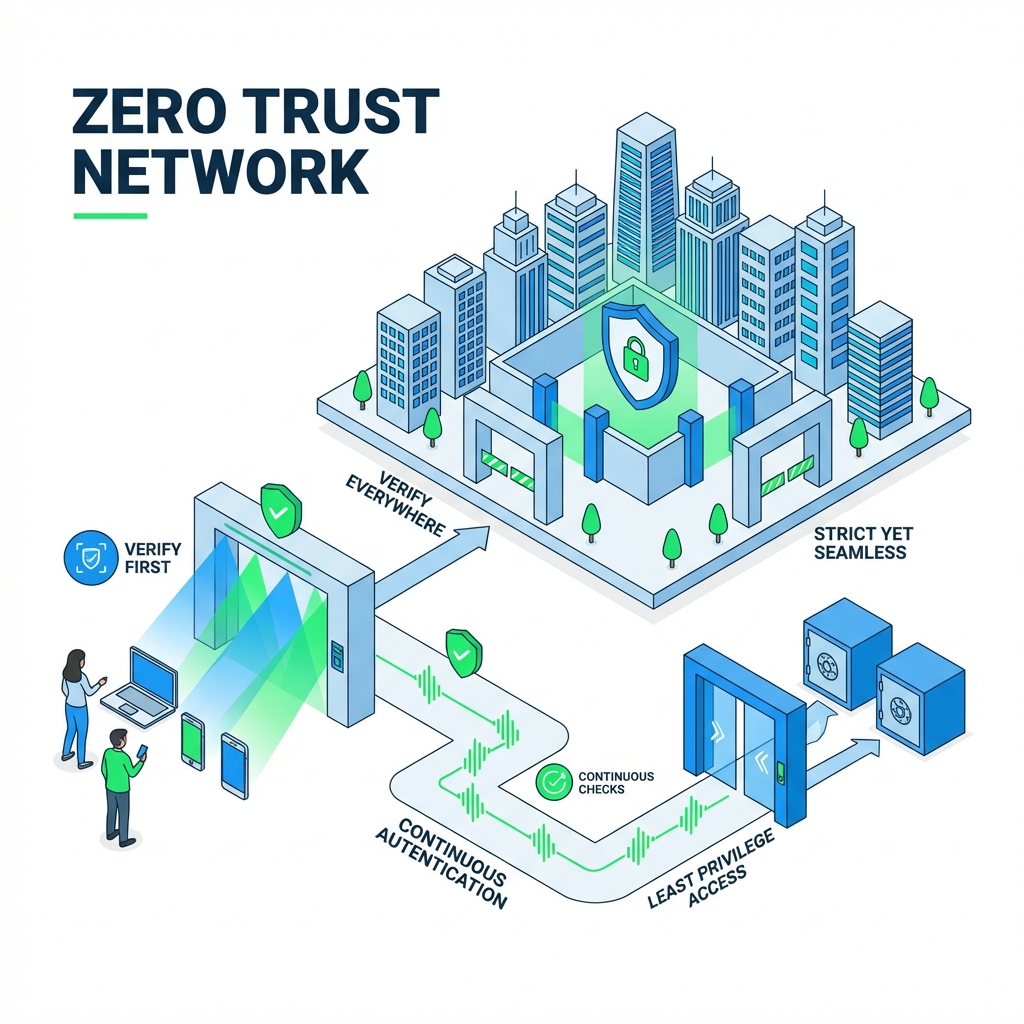
Verify identity at every access attempt with adaptive MFA.
Restrict access to only what is necessary for the user's role.
Limit lateral movement by securing individual resources and data segments.
Eliminate blind spots entirely. Gain granular insight into all identities, hardware devices, and applications accessing your network infrastructure to ensure no entity goes unmonitored.
Go beyond static monitoring. Analyze all entities and activities continuously to flag suspicious behavior, detect privilege abuse, and identify stealthy threats the second they appear.
Stop attacks in their tracks. Instantly force additional authentication challenges, restrict administrative privileges, or completely quarantine suspicious devices when high risk behaviors are identified.
Hardening your security posture is a continuous process. Resolve discovered weaknesses proactively by deploying patches, updating configurations, and resetting exposed credentials before attackers find them.
Zero Trust operates on the core principle of never trust, always verify. All users and devices remain completely untrusted until their identity and context are thoroughly proven, regardless of whether they are sitting inside the corporate network or working remotely.
Traditional security focuses heavily on fortifying the outer perimeter, assuming everything inside the moat is safe. Zero Trust assumes the perimeter has already been breached and focuses on securing individual access points, applications, and identities.
ManageEngine strongly recommends an identity centric approach. Securing user identities and hardening endpoints is widely recognized as the fastest, most effective way for an enterprise to rapidly reduce operational risk and begin their Zero Trust journey.